
Insights
Insights

The NICE HST process (3/3) – challenges associated with appraising treatments for ultra-rare indications
In previous blog posts, we explored the origins of NICE’s Highly Specialised Technologies (HST) process and compared it with the Single Technology Assessment (STA) process. In this blog, we review the first 10 HST appraisals and identify key issues raised by the Evidence Review Groups (ERGs)

Reporting current research with living systematic literature reviews
Although considered the gold standard of quality research, systematic literature reviews (SLRs) are very resource intensive (e.g. long timeline, high budget) [1]. This, in combination with the broader issue that “research outpaces understanding,” SLRs get quickly out-of-date [2].

The NICE HST process (2/3) – differences in assessment of cost-effectiveness between the HST and STA
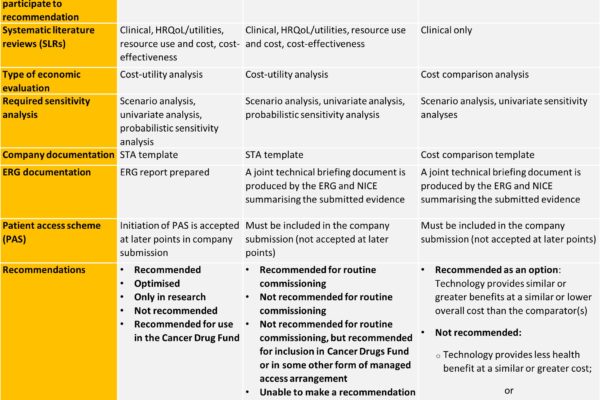
In a previous post, we discussed the origins of the NICE Highly Specialised Technologies (HST) process for the evaluation of therapies for rare diseases. In this blog, we examine the key differences between the Single Technology Appraisal (STA) and the HST processes. There are numerous differences between the two processes; from timescale to individual requirements. Formal guidelines for the HST process are available here.
The NICE HST process (1/3) – origins and current state of affairs
Treatments for very rare conditions represent a unique challenge to payers. Extremely low patient numbers mean that often only Phase 1/2 trial data are available, and that natural history, quality of life and resource use data are limited. Combined with high unit costs, these evidence challenges result in estimates of cost-effectiveness that are subject to a greater degree of uncertainty.
The Health Technology Assessment (HTA) process is well-suited to the evaluation of therapies which are expected to benefit large numbers, but concerns exist as to their application to orphan therapies, and whether standard HTA processes accurately reflect societal preferences for treating rare diseases (1).
Is the NICE FTA process resulting in faster access to the most cost-effective therapies?
On the 1st April 2017, the National Institute for Health and Care Excellence (NICE) introduced a fast-track appraisal (FTA) process, with the aim of providing quicker access for patients to the most cost-effective new treatments. Two years on, has this objective been achieved? Since the introduction of the FTA process, final FTA guidance has been published for only four technologies (TA486, TA497, TA521 and TA572) [1]. All four therapies were considered based on a cost-comparison.

Will discount rates change for UK HTA
Written by David Trueman, Director
The rate at which future costs and outcomes are discounted has long stood at ...

Why multi-company collaboration for HTA evidence generation in rare diseases is a good thing
Project HERCULES is a unique international multi-stakeholder collaborative project set up by Duchenne UK to develop tools and evidence to support Health Technology Assessment (HTA) and reimbursement decisions for new treatments for Duchenne Muscular Dystrophy (DMD). It brings together eight leading pharmaceutical companies, academics, patient organisations and advisers to develop and build a better evidence base for DMD to aid the pricing and reimbursement stage of drug development.

Rapid reviews: what you need to know
Written by Julie Fricke (Systematic Review Analyst) and Neil Webb (Head of Systematic Review)
As described in the ...
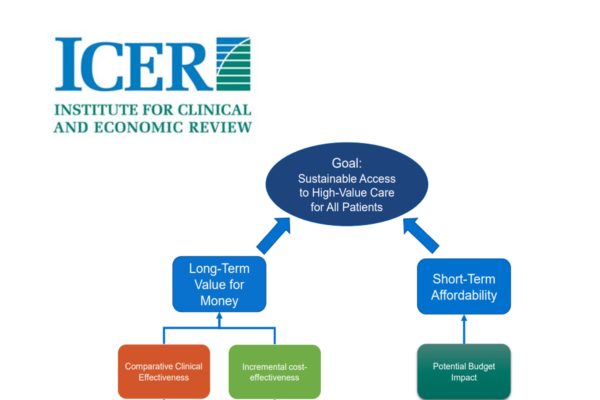
Explaining ICER, America’s answer to NICE
The Boston-based Institute for Clinical and Economic Review, otherwise known as ICER, has caught the attention of important stakeholders in the past few years. Between reports for high-impact drugs that have stirred public opinion (such as a review of Orkambi for cystic fribrosis) and its increasing popularity with healthcare payers, ICER is becoming a key player in transforming the drug-pricing mechanism in the US.

The importance of peer-review for your search strategy
The search strategy is the foundation of a well-conducted systematic literature review (SLR) and is the fundamental element that can affect the overall quality of the results of the final review (1, 2). The aim of a search string is to achieve a balance between sensitivity (capturing all relevant articles) and precision (eliminating irrelevant hits); a lack of balance has implications on the quality of the evidence identified and the resources required to conduct the review.

Mixture cure models: modelling survival when some patients are cured
The standard survival analysis techniques used in oncology modelling, such a parametric survival curves, provide a useful way of estimating transition probabilities to populate economic models. These models are predicated on the idea that at some point all patients will experience the event, be it disease progression or death (more specifically, death due the cancer being studied) and are asymptotic to 0. For many applications this assumption is not problematic.

Duchenne UK’s Project HERCULES awarded prestigious rare disease award
Written by Juliet Mumby-Croft, Director
Project HERCULES is a unique international multi-stakeholder ...
No results found.