
Insights
Insights
Why multi-company collaboration for HTA evidence generation in rare diseases is a good thing
Project HERCULES is a unique international multi-stakeholder collaborative project set up by Duchenne UK to develop tools and evidence to support Health Technology Assessment (HTA) and reimbursement decisions for new treatments for Duchenne Muscular Dystrophy (DMD). It brings together eight leading pharmaceutical companies, academics, patient organisations and advisers to develop and build a better evidence base for DMD to aid the pricing and reimbursement stage of drug development.

Rapid reviews: what you need to know
Written by Julie Fricke (Systematic Review Analyst) and Neil Webb (Head of Systematic Review)
As described in the ...
Explaining ICER, America’s answer to NICE
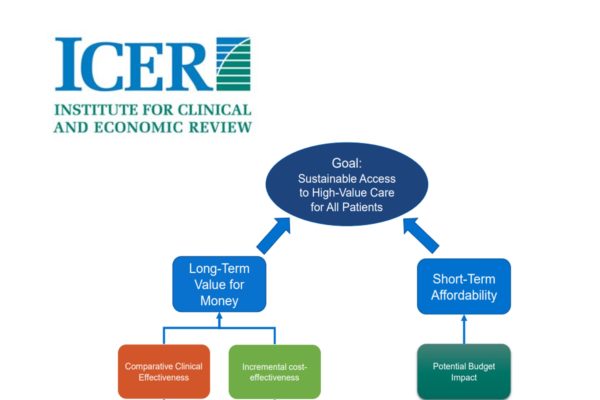
The Boston-based Institute for Clinical and Economic Review, otherwise known as ICER, has caught the attention of important stakeholders in the past few years. Between reports for high-impact drugs that have stirred public opinion (such as a review of Orkambi for cystic fribrosis) and its increasing popularity with healthcare payers, ICER is becoming a key player in transforming the drug-pricing mechanism in the US.
The importance of peer-review for your search strategy
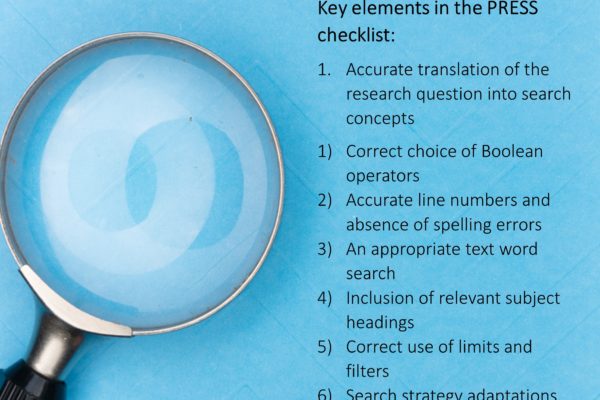
The search strategy is the foundation of a well-conducted systematic literature review (SLR) and is the fundamental element that can affect the overall quality of the results of the final review (1, 2). The aim of a search string is to achieve a balance between sensitivity (capturing all relevant articles) and precision (eliminating irrelevant hits); a lack of balance has implications on the quality of the evidence identified and the resources required to conduct the review.

Mixture cure models: modelling survival when some patients are cured
The standard survival analysis techniques used in oncology modelling, such a parametric survival curves, provide a useful way of estimating transition probabilities to populate economic models. These models are predicated on the idea that at some point all patients will experience the event, be it disease progression or death (more specifically, death due the cancer being studied) and are asymptotic to 0. For many applications this assumption is not problematic.

Duchenne UK’s Project HERCULES awarded prestigious rare disease award
Written by Juliet Mumby-Croft, Director
Project HERCULES is a unique international multi-stakeholder ...

htasurv: a Stata module for performing survival analysis in economic evaluations
Written by David Trueman, Director
htasurv is an open source Stata module for assessing alternative parametric ...

Ten guiding principles for model write-ups and economic sections of HTA submissions
The following pointers aim to provide practical guidance to strengthen the communication of your economic case, avoid the introduction of mistakes and make the deadline.
1. Validate your model first. Then get someone else to validate it.

Model methods: part 2 – finding an elegant solution
When developing a model methodology, there should be a Eureka moment. The moment when you find a model structure that reflects natural history, captures the relative benefits and harms of the new intervention versus standard of care (SoC) and uses the minimum number of assumptions. The methodology chosen should diminish uncertainty and not add to it as a result of burdensome complexity or layers of assumption that render a conclusion almost impossible.

Model methods: part 1 – to include or not to include?
Written by Juliet Mumby-Croft, Director
It’s an accepted principle that the structure of a cost-effectiveness ...
No results found.