Written by Abby Paine and Jack Scerri
What better way to spend a Saturday morning than volunteering to lead an interactive mathematics workshop for a group of enthusiastic young students! That’s exactly what two of our staff did recently when they led a Royal Institution (Ri) Mathematics Masterclass for 50 students aged 13–14 years of age and attending local schools in the Maidenhead area.
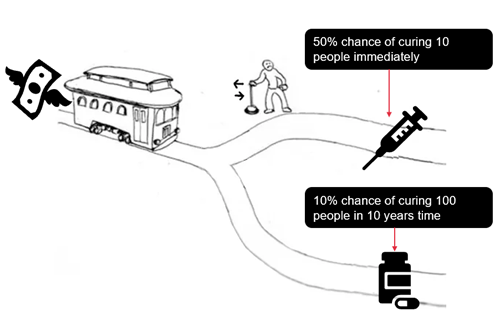
Our colleagues, Abby Paine (statistician) and Jack Scerri (health economist) encouraged the students to consider how developing maths and science skills beyond school can open the door to a variety of rewarding careers, including those in medicine. Engaging with the students through a series of games and interactive examples, they demonstrated how statistics, probability, economic and ethical considerations have a fundamental part to play in decision making for health care systems around the world, including for the National Health Service (NHS) in the UK. Using the “Trolley problem” healthcare decision example, the students were encouraged to think through how we not only need ethics for decision making in healthcare, but also mathematics and economics to ensure we make fair decisions.
Many of the students were not previously aware that a career in the pharmaceutical industry is an option with qualifications in mathematics and/or economics. Abby and Jack were able to give an insight into some of the rewarding career opportunities available in helping new medicines become available to the people who need them most.
The RI Masterclasses are run by a dedicated team of volunteers, and are designed to encourage and inspire young people in the wide range of applications for mathematics, usually covering concepts that are not taught as part of a school curriculum.
If you would like to learn more about how advanced statistics is used to model treatment effects and healthcare costs, please contact Source Health Economics, a HEOR consultancy specialising in evidence generation, health economics, and communication.